
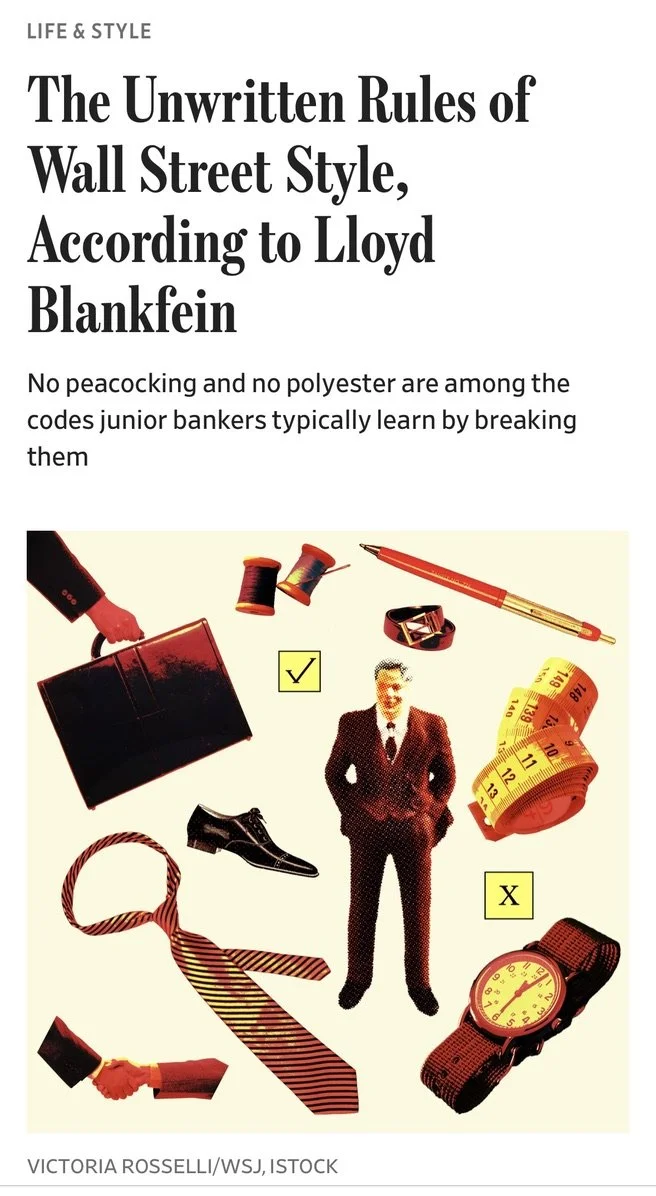
Unwritten rules govern Wall Street dressing, particularly for those in entry-level roles. Crossing the line (to one's detriment) is easy, but there are ways to avoid the inevitable pitfalls. Check out my advice on how to navigate them in this WSJ article.
Recently my styling advice was shared in a front page WSJ article, “The Unwritten Rules of Wall Street Style, According to Lloyd Blankfein” by Ray Smith. Click above to read the article, and you can check out my more detailed thoughts below.
Whenever entry-level finance guys hire me, I’m always ultra-careful not to be too aggressive with their styling. This is not a flex-dressing situation. That means no obvious brand names and nothing flashy. There are so many pitfalls to avoid, and that includes not just luxe accessories like high-end watches and statement clothing brands, but also styling details. If the client is joining an office where suits are de rigeur, we keep the tailoring details quiet and understated. That means notch lapels, button cuffs, and pants with belt loops (as opposed to peak lapels, French cuffs, and side adjusters).
The client has to dress in keeping with the salary he’s making; otherwise, he risks alienating his superiors and clients and/or looking like he doesn’t need the job anyway. My shopping advice to someone starting a career in a white-collar industry is to come up with a budget that aligns with his salary, and build his wardrobe from there. With that, I typically look to mid-budget, classy brands where he will get good value for his investment (again appropriate for his salary + signing bonus). These include Hugo Boss, Theory, and some department store private label/house brands. If we do custom tailoring, I always keep the details subtle — see above. For accessories like shoes and belts, Johnston and Murphy is a good entry-level option. You can also get great deals at Saks Off-Fifth and Nordstrom Rack.
Watches are a big deal in the finance world and need to be handled accordingly. While for guys further along in their careers, a gorgeous statement watch can engender respect, for junior guys, it’s just plain tone deaf. It sounds dramatic, but wearing a showy watch really does spell instant death. He can keep it tried and true with something like a Seiko, Nixon or Shinola, and there are also lots of budget-friendly microbrands like Baltic, Farer and Helios that give him an opportunity to express himself aesthetically without turning anyone off.
When a client gets further along in his career, that’s when we start removing guardrails. Brand names are OK, but my advice is always to stay in keeping with who you are as a person. If you’re buying fancier brands just because you can or because you think it will make you be perceived in a more favorable way, then it’s going to fall flat. It’s the ultimate poser move to buy something just because of the brand or because you’re trying to emulate someone else. Confidence when it comes to image is being true to yourself, and dressing in alignment with that. I always tell clients to only buy things they truly love. That absolutely shines through when they wear it.
If you’d like more specifically-tailored styling advice, contact me to see if we’re a fit to work together.
Yours in style,
Julie